
#Physics #8-th grade
Theoretical notes: All materials are made up from atoms, and all atoms consist of
protons, neutrons and electrons. Protons have a positive electrical charge. Neutrons
have no electrical charge (that is they are Neutral), while Electrons have a negative
electrical charge. Atoms are bound together by powerful forces of attraction existing
between the atoms nucleus and the electrons in its outer shell. When these protons,
neutrons and electrons are together within the atom they are happy and stable. But if
we separate them from each other they want to reform and start to exert a potential of
attraction called a potential difference.
Now if we create a closed circuit these loose electrons will start to move and drift back
to the protons due to their attraction creating a flow of electrons. This flow of electrons
is called an electrical current. The electrons do no flow freely through the circuit as the
material they move through creates a restriction to the electron flow. This restriction is
called resistance. Besides the resistance, the electric current is defined by another two
physical measures: Voltage and Current. The voltage is defined as the work done by the
current over the electric charge, representing the potential of the circuit. The current is
the number of charges that pass through a conductor in a fixed amount of time and
could be thought of as some kind of "velocity" of the charges.
The electric component whose job is to limit the current that passes through a conductor is called a resistor. Because of the properties of the electric current, it behaves differently depending on the way the resistors are connected. There are two types of resistor connections: parallel connection and series connection. We say two or more resistors are connected in series when the same current passes through all the resistors. This means the current enters the second resistor as soon as it exits the first one. Here is an example of series connection:
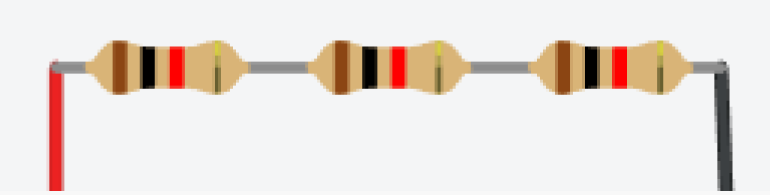
In order to see a live result, we are going to use LEDs instead of resistors. The longer leg of the LED is the anode, meaning it connects to +. The shorter leg is the cathode and should be connected to
The 3V battery will be the source of the current. the red wire is the + of the source and the black wire is the - terminal of the source.
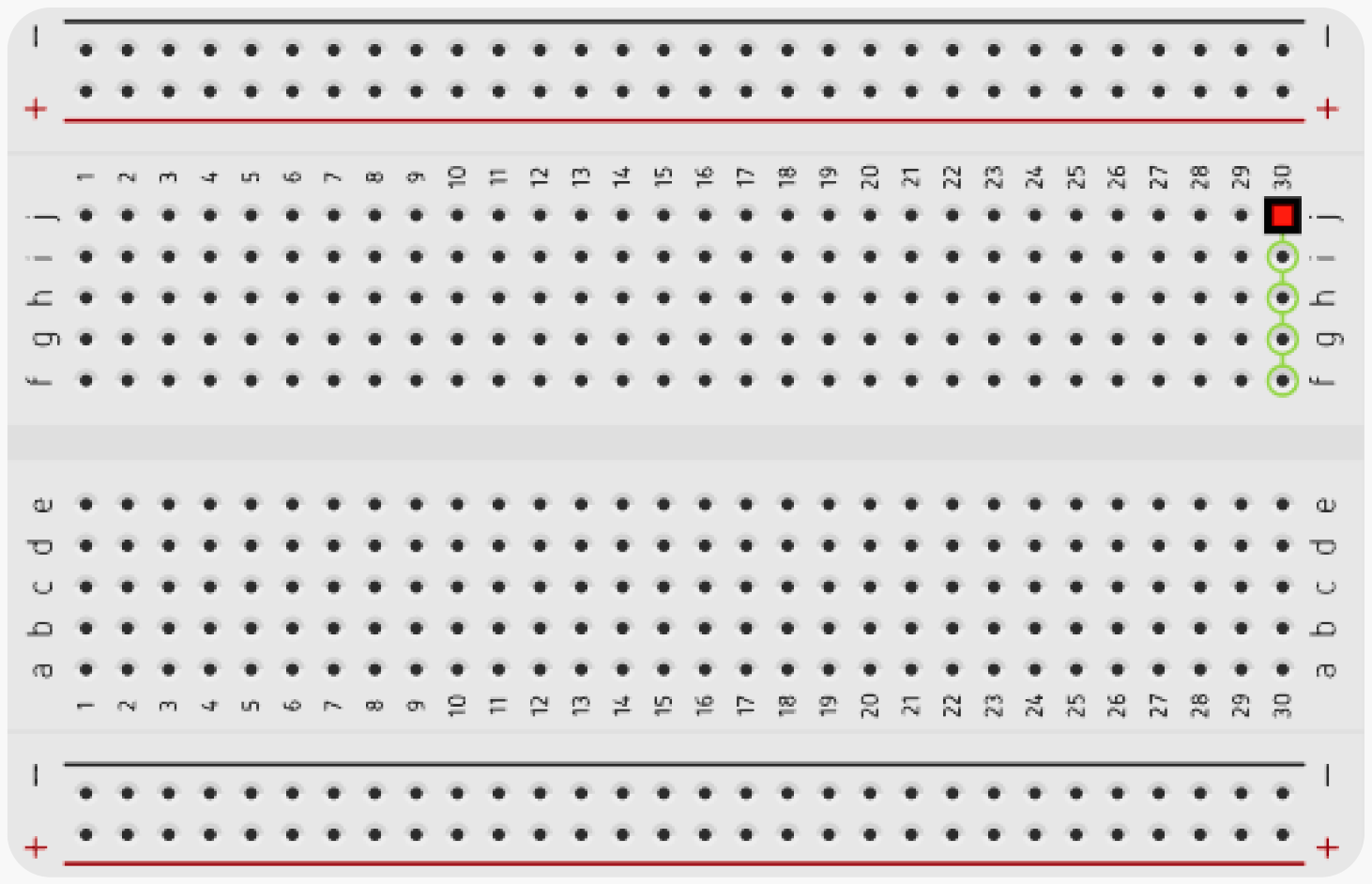
The breadboard is a component created to make the connection of another electronic components easier. All the pins from the + line are connected together. All the pins from the - line are connected together. All the rest of the pins are connected together in each 5-pin raw, as shown in the picture.
Take four of the LEDs and connect them in parallel. Question: What happens if you remove one led from those three? Why?
Take four of the LEDs and connect them in parallel. Show the result: Question: Why are the LEDs brighter when they are connected in parallel? Question: What happens if you remove an LED from the parallel connection? Why?